

Components of a great Employee Experience Strategy
These past years I’ve had the opportunity to talk to many companies that created exceptional EX Strategies. I’ve summarized what's generally included.

Written by
Joris Luijke, Co-Founder & Co-CEO
"Employee Experience" in Companies
Over the past decade, interest in “Employee Experience” (EX) has skyrocketed. If we look at Google Search Trends data, the term averaged a score of just 10 from 2004 to 2010, indicating it was a relatively niche concept. Fast forward to recent years, and the average interest has surged to 95+.
This highlights a growing recognition of the importance of Employee Experience in the workplace. Yet, even though lots of companies talk about Employee Experience (and even hire for Employee Experience roles), many still struggle to define what it means to be successful at EX.
These past years I’ve had the opportunity to talk to many companies that created exceptional EX Strategies. In this post I’ve summarized how these are generally structured.
When I talk about an Employee Experience (EX) Strategy, I refer to the concrete plan of action to achieve Employee Experience excellence. Your strategy functions like a roadmap to guide you from where you are now to where you want to be, with the resources available to you.
First, a crucial thing to know when creating your EX Strategy
Before we dive into the different components of a successful EX strategy, it is important to know that creating any strategy without a Strategy Framework is exceptionally hard.
For this reason, Go-to-Market teams often use the Customer Journey Map as their strategic framework. And the core framework that provides structure for successful EX strategies is the Employee Journey Map.
Here are five reasons why this framework makes creating a strategy easier:
- It creates structure and clarity: Strategy frameworks like the Employee Journey Map offer a clear roadmap for decision-making. Without them, it’s easy to lose direction. The map also helps break down complex problems into manageable parts.
- It helps you align stakeholders: Frameworks provide a common language and understanding for all stakeholders. Without them, aligning everyone’s vision and expectations becomes more difficult.
- It provides a built-in way to measure progress: Strategy frameworks come with built-in benchmarks and metrics for success. Without a framework, it’s harder to set clear, measurable goals and track progress effectively.
- It prevents you from overlooking key elements: Frameworks ensure that all critical elements of a strategy are considered. Without a journey map, it’s easier to overlook key moments that matter.
- It makes it easier to gain buy-in: Frameworks lend credibility to the strategy, making it easier to gain buy-in from key stakeholders. Executives already familiar with the customer journey will naturally understand the employee journey.
Components of a great EX Strategy
The EX Strategy puts a holistic experience for employees at its center. Your overall HR Strategy, in addition, will encompass areas such as employee relations, compliance, and workforce planning.
A key development over the past years is the increased importance of EX Strategy within the overall HR Strategy. A Mckinsey report published in 2022 explains that modern HR teams have elevated EX as core the the HR operating system, highlighting that “Excelling along the Employee Experience (EX) journey has been the strongest emerging HR trend.”
In other words, more teams are putting EX strategy at the center of their overall HR strategy. When you’re creating your EX strategy you’ll want to plan for these components:
- Business Context
- Research
- Framework (your Employee Journey Map)
- Success Measures
- Delivery
- Optimization
I’ll walk through all of them and provide best-practice examples throughout.
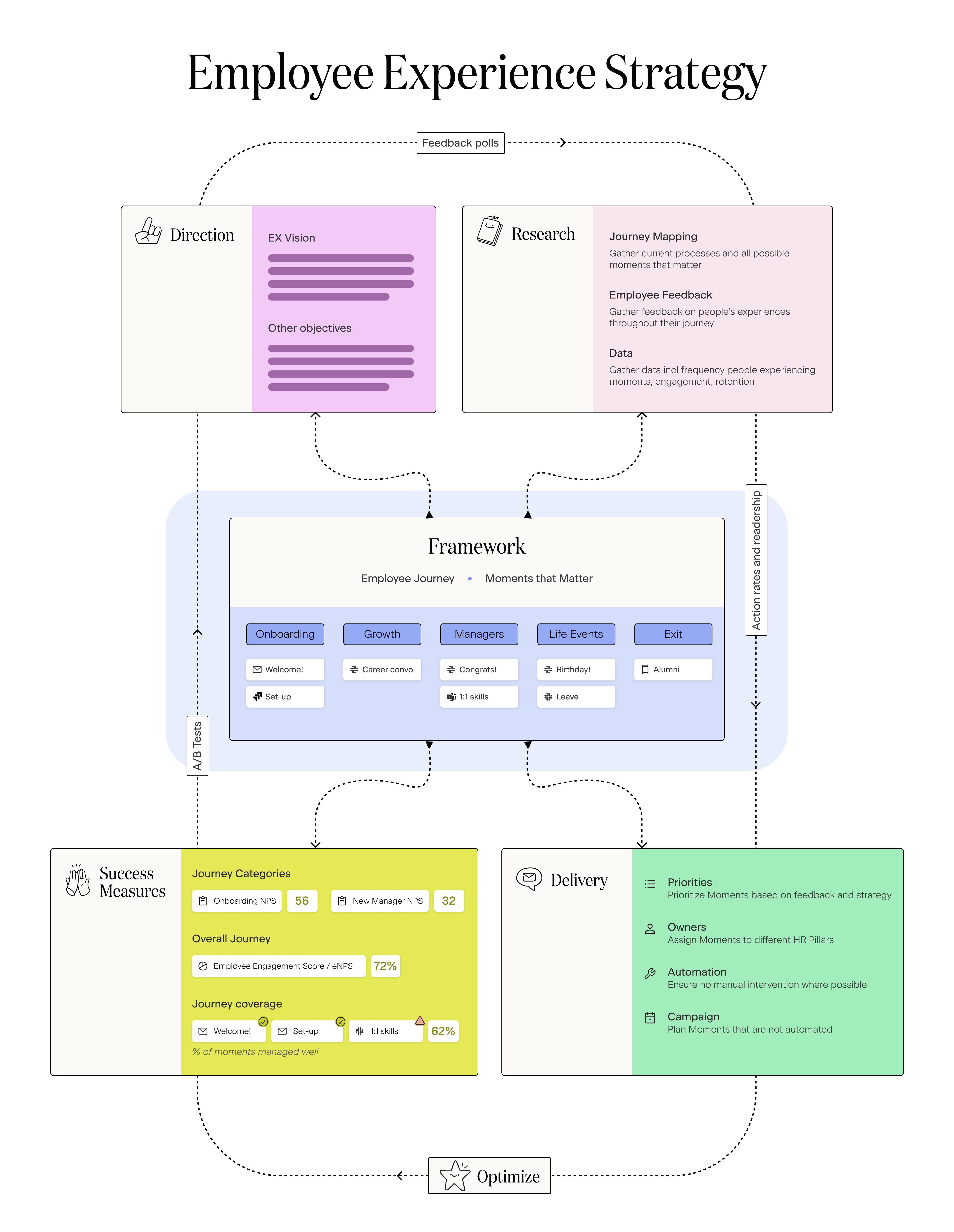
#1. Business Context
The first step in creating any EX strategy is to understand the context and needs of the business to set the right direction of your overarching EX strategy. Whatever is most important to the business should be what drives the direction and focus of your EX plans.
Getting the right business context is similar the how you’d prepare for a HR strategy offsite:
- Understand the macro context
- Understand the business context by asking your CEO questions
- Understand departmental needs by asking your department heads questions
Get some question you can use for each. This context will inform your overall EX vision.
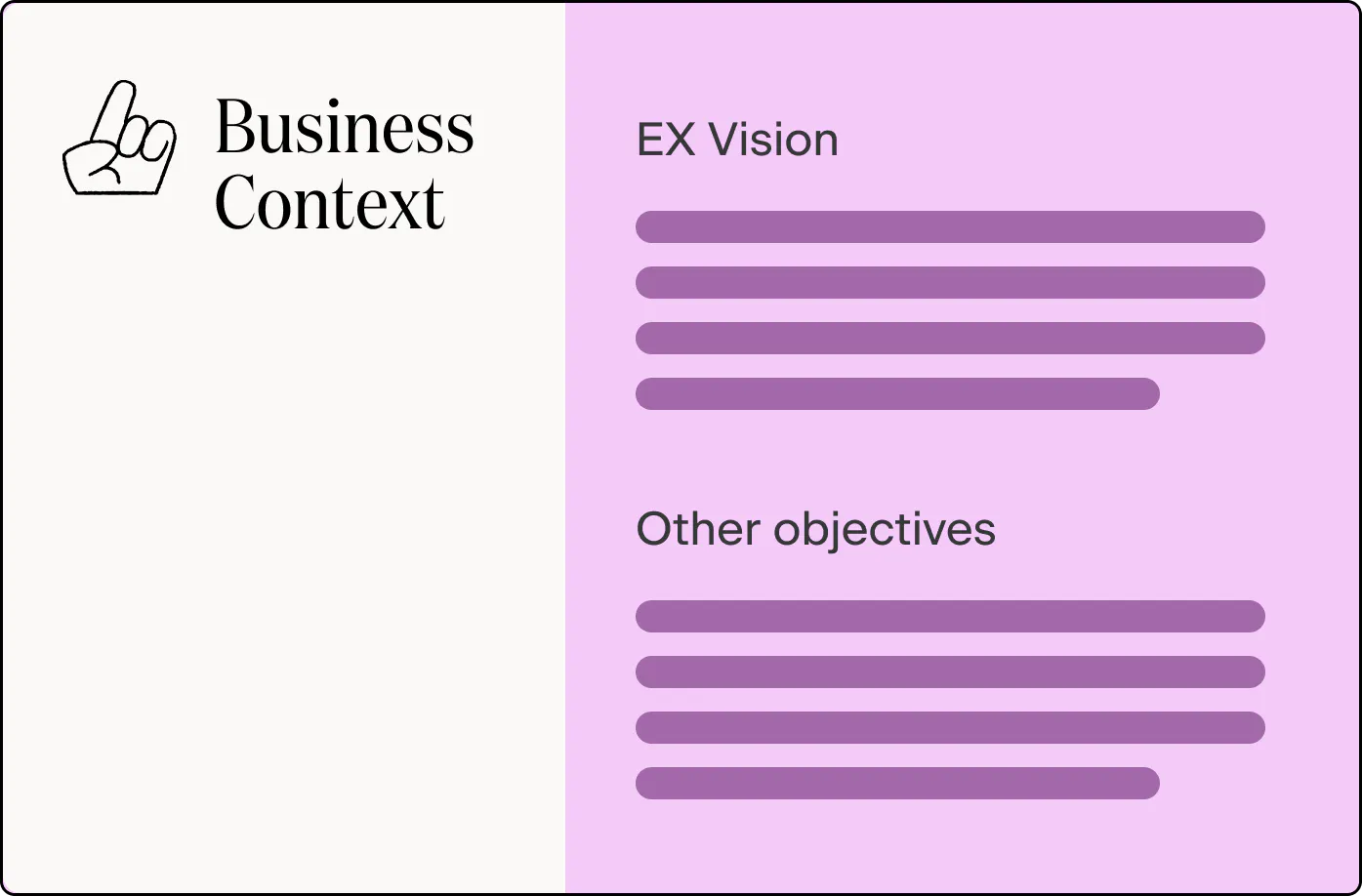
EX Vision
The specific challenges your organization faces should shape the vision for your Employee Experience strategy.
Is your CEO concerned about persistent employee performance issues? Does the business struggle with excessive friction in day-to-day operations? Are hybrid or remote work models leading to feelings of disconnection among employees and leadership?
For instance, if the focus is on "Manager & Employee Enablement," your vision could be: "Create a seamless, personalized employee journey that empowers both managers and employees to excel."
Additional objectives (or Requested improvements?)
Are there any specific areas you/your business wants you to improve? If so, it’s good to write those down also.
These may include known areas that your team or the business wants to fix, for example: improve onboarding, integrate different solutions in our HR Stack, help new managers quickly onramp in their new managerial role, etc.
#2. Research
After getting the business context, the second step is to gather data that will help tailor your EX strategy to the needs and expectations of employees and the moments that matter in their journey.
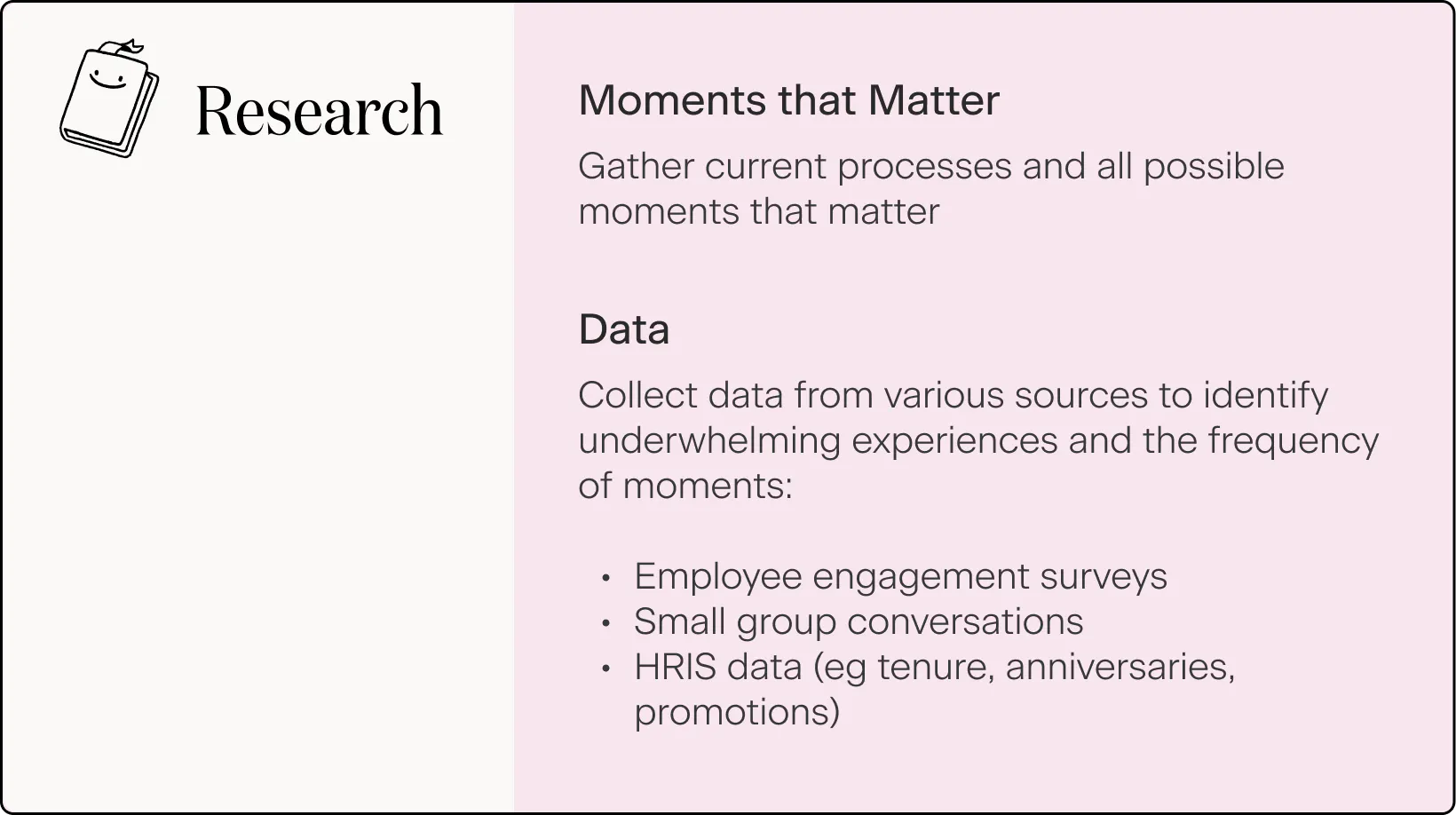
Assess/Gather your company’s Moments that Matter
In preparation to create an Employee Journey Map, you’d have to consider all possible Moments that Matter and write down any processes you currently have in place already.
To gather this list may feel like a daunting process as there are many possible Moments-that-Matter and Touchpoints in an Employee Journey Map to consider.
To help you get started, use Pyn’s free Journey Design Tool that includes a pre-populated Employee Journey Map with an extensive catalog of Moments that Matter.
Data
Improving the employee experience requires empathizing with employees, understanding their needs, and crafting customer-centric experiences that help folks feel confident and excited about each moment in their journey.
Besides asking employees about their experiences, you should also gather data that could shed a light on where people’s experiences are underwhelming and how often people experience moments.
Some examples of data to collect:
Employee engagement surveys
Perhaps you recently ran an engagement survey? The reports may shed light on people’s experiences at your company.
Small group conversations
Read this blog by Felicitas Schweiker on how she included stakeholders in the design process. Some companies take IDEO’s Design Thinking Approach to gathering employee feedback on the different Journey Categories (eg Onboarding Journey, New Manager Journey, etc) by running a Design Thinking Workshop.
From your HRIS:
How many employees leave in the first year? This data may reveal interesting insights on your hiring and onboarding process.
Do you know how many employees were promoted to manager last year, went on parental leave, celebrated a 10yr anniversary? This data will provide insights into what moments you may decide to prioritize.
#3. Framework - The Employee Journey Map
An Employee Journey Map helps define and prioritize the work that needs to be done to ensure that the employee experience is top-notch.
It encompasses all of the experiences of an employee, including the moments that matter, from before their first day on the job until after their last day.
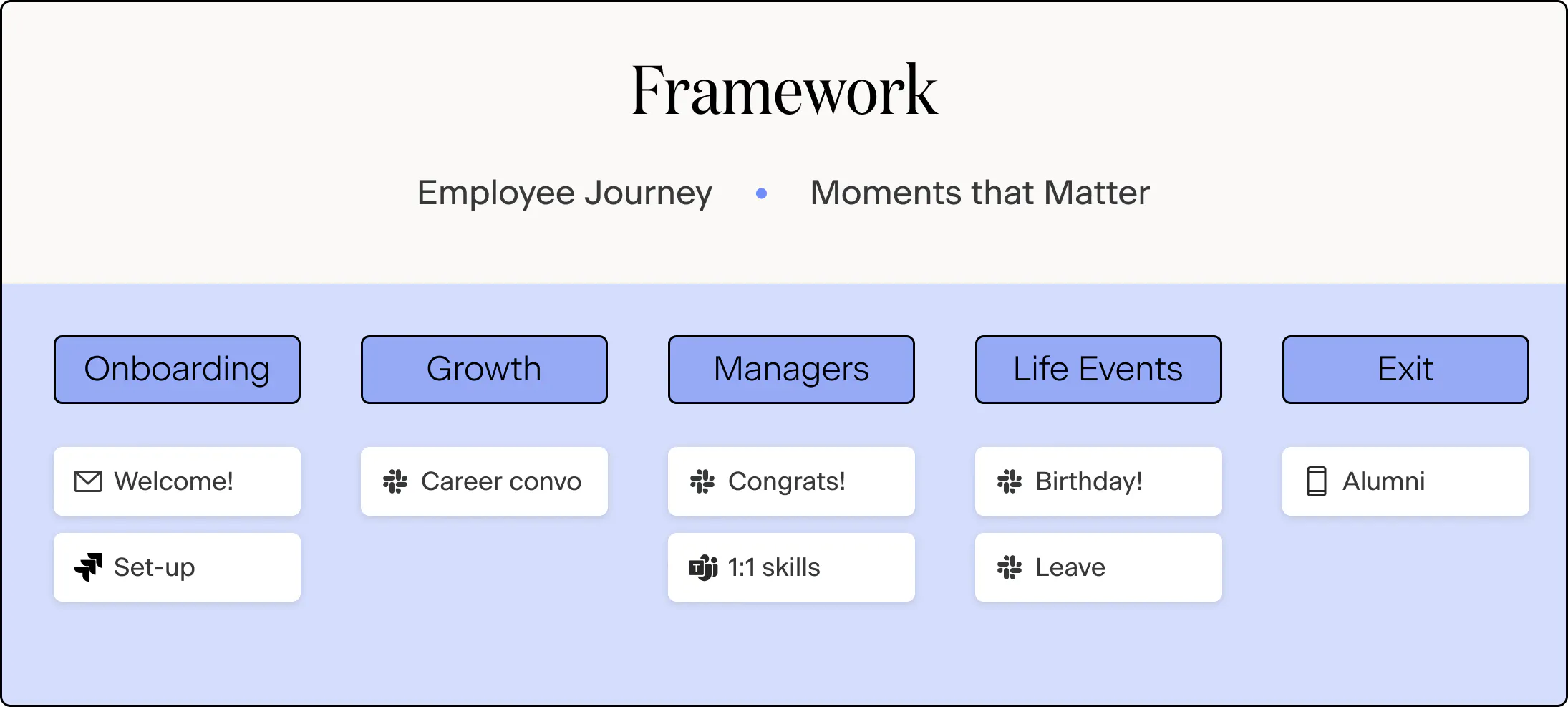
At Pyn, we’ve created a free employee journey designer that lets you create your map collaboratively with your colleagues. Additional resources include:
- A real-world example from Ashley Woodland, Director of Organizational Development at BOA on how she uses Pyn for Employee Journey Mapping
- Short blog on getting started with Employee Journey Mapping
- Employee Mapping Facilitation Guide to create map with your team
- On-demand webinar that covers the fundamentals of Employee Journey Mapping
- 2-page guide to creating your first Employee Journey Map
#4. Success Measures
Your EX strategy should include success metrics tied to your Employee Journey Framework. Some measures of EX success are “leading measures,” or predictive indicators that forecast future performance. Others are “lagging measures” that reflect past outcomes and indicate whether goals have been achieved.
Using a combination of leading and lagging indicators is powerful because it provides you with a comprehensive, balanced perspective for decision-making.
Leading indicators offer foresight, helping you anticipate trends and act proactively, while lagging indicators provide historical context and validate the effectiveness of past actions.
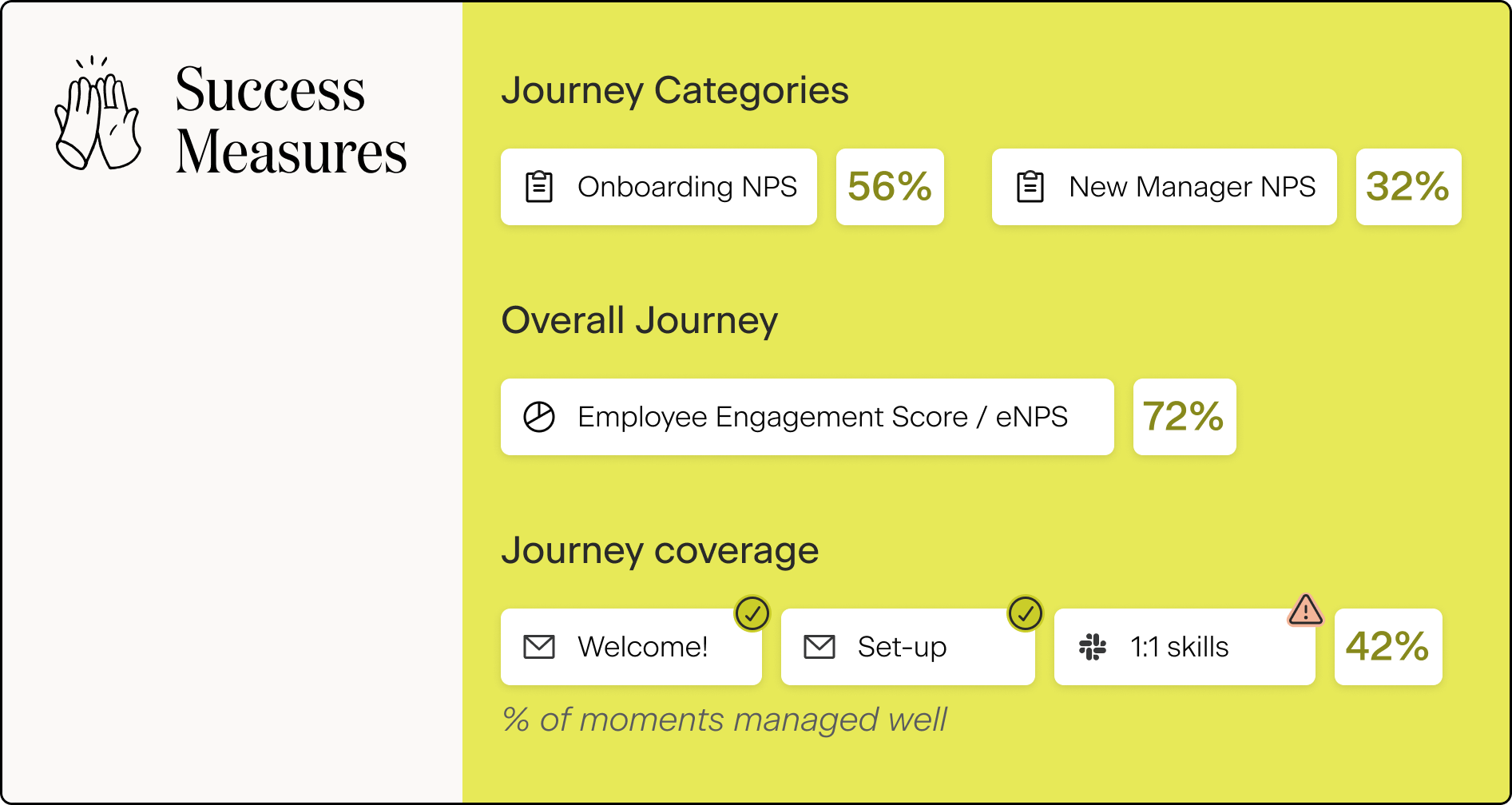
Journey Categories (Lagging Success Measure):
Employee sentiment about their experiences at the different parts of the journey. Different parts of the journey include, for example, onboarding journey, new manager journey, and the exit journey. For example, you can survey every new manager about their experience becoming a new manager. You could also send short polls at important moments, like when an employee returns from parental leave.
Overall Journey (Lagging Success Measure):
Employee engagement or eNPS can be measured by surveying your people on the general sentiment of their employee experience in the organization by measuring the percentage of employees who answer engagement related questions with ‘agree’ or ‘strongly agree.’ Generally, an overall engagement score of 80% is considered very strong.
Journey Coverage (Leading Success Measure):
This is the percentage of Moments that Matter that are proactively managed. For example, you may identify 100 Moments that Matter. They’ll likely include Moments like the “first day,” “return from parental leave,” or “promotion to manager.”
You can evaluate how many of those moments are managed well, meaning that consistent point-of-need guidance is delivered. Importantly, in order to ensure no-one is missed and instructions are consistent, guidance would need to be delivered proactively and automatically to not rely on manual interventions or self service.
If 35 of those 100 moments are managed well, your “Coverage” is 35%. Needless to say that 100% is the ultimate goal for every team. HR teams that get above 80% journey coverage have an excellent EX.
#5. Execution
A big part of your strategy should be delivering your approach and identified moments to the business.
Interestingly, the EX strategy framework helps HR think differently about delivery than the traditional HR Pillars based approach (L&D, Recruiting, HR Ops, etc) where each HR team has a different process to decide on what’s important to improve their respective areas and on how they deliver their services to the business.
Instead, the Employee Journey Map provides a single perspective on what’s important: ensuring a great experience to employees across their journey. Each pillar manages parts of the overall Employee Journey and the moments within. This is a more effective way to manage HR work and communicate plans to the business.
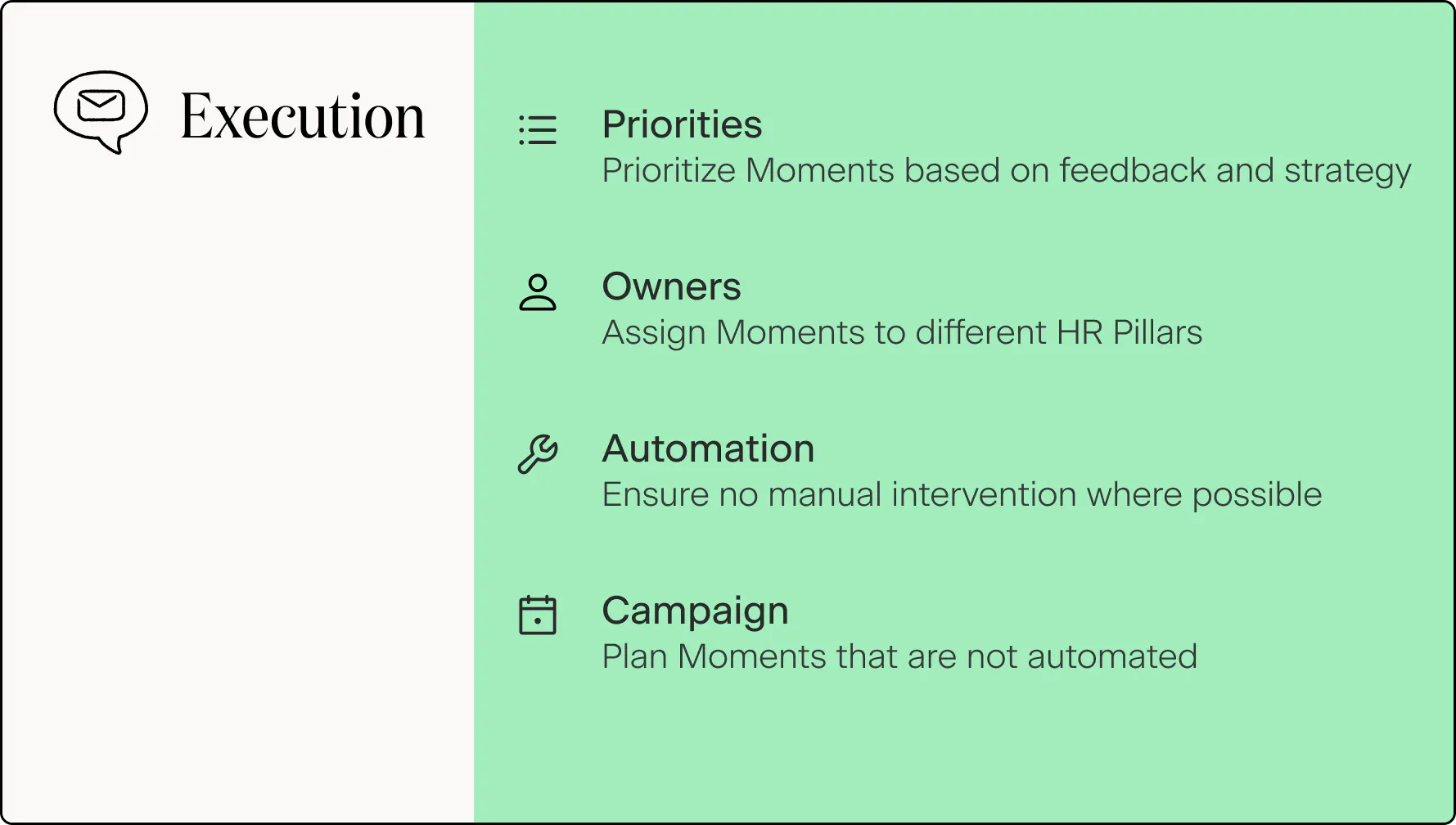
This Ultimate Guide the Employee Journey Mapping goes into detail how, after you have mapped out your journey map and all the moments that matter, you’d move to action by:
- Prioritizing: Prioritize Moments based on feedback and strategy
- Assigning Owners: Assign Moments to different HR Pillars
- Automating Moments: Ensure no manual intervention where possible
- Creating Campaigns: Plan Moments that are not automated

How Pyn can help: Pyn’s Employee Journey Designer lets you set owners and priorities across all moments that matter to help you move from plan to action!
After, Pyn lets you export your map to present the Employee Journey with stakeholders in the company like your management team.
#6. Optimization
After implementing your EX strategy, it's important to continuously refine and optimize it. Several methods can help you effectively identify what's working and what needs adjustment.
Action rates and readership: Nothing tells you if the guidance you sent to employees is working better than readership and action rates. For example, if you send newly promoted managers guidance on how to have a kick off 1:1, but they don’t read your instructions or take action - it’s pretty much pointless.
There are several ways to adjust your methods, including better personalization, better timing, different content, or delivery channel. Get more detail on better employee communications in our ebook: 5 Employee Communication Tips every HR Professional Should Know.

A/B tests: If your workforce is large enough, A/B testing can be a great way to test different tactics to deliver a better experience. For example, if you’re asking hiring managers to select an onboarding buddy what works best, sending a nudge via email linking to your HRIS or sending them a Slack/Teams message. You can test this with a tool like Pyn!
Feedback Polls: Implement short polls at different stages of the employee journey to measure people’s experiences. For example, once someone has returned from parental leave and is re-onboarded it's good to send the new parent a short poll to ask about their experience (automatically, of course).
Joris dreamt of having Pyn as Head of People at Atlassian and Squarespace. Now dreams of getting a sleep-in on Sunday.