What goes in a 1:1 meeting template? A free weekly agenda

Use this Pyn within the product. Learn how.
Updated November 2026
1:1 meetings are time for the conversations that don't fit into the day-to-day. The focus is on what your direct report needs and how you can help. It is their time, and over the first few meetings they should come to own the agenda.
This template gives you a structure to start from. If this is your very first 1:1 with someone, use the first one-on-one template instead; it does different work.
The 1:1 meeting template
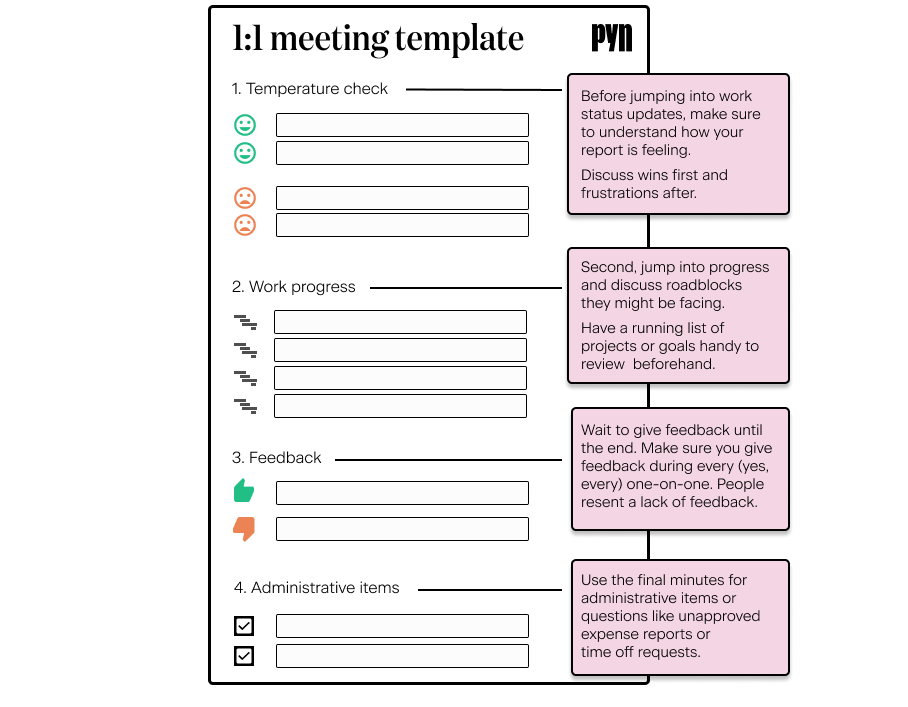
Four parts, thirty minutes. Copy it into your notes, or make a copy of the Google Doc version.

1:1 meeting template
1:1 with [name] · [date]
1. Temperature check (5 min)
How are you feeling this week?
Wins since last time:
Frustrations since last time:
2. Work progress (10 to 15 min)
For each goal, project or OKR: on track? Happy with the quality? Any blockers?
[goal 1]
[goal 2]
[goal 3]
3. Feedback (5 to 10 min)
From me (situation, behaviour, impact):
From you: one thing I could do 10% better:
4. Admin and actions (5 min)
Actions from last time:
New actions, with owners:
Time off, expenses, upcoming reviews or surveys:
Next 1:1: [date]
Want to tailor it for a specific team or role? See custom one-on-one templates for managers and employees.
How to run each part of the 1:1
1. Temperature check
Resist the urge to jump into status updates. Spend the first few minutes on something light and personal: weekend plans, kids, pets, last night's game. Then ask the simple, often skipped question: "How are you feeling today?"
Start with wins. "What went well this week?" or "Did anything make you happy this week?" Wins can be small.
Follow with frustrations. "Did anything frustrate you this week?" or "What didn't go as planned, and how did that feel?" Frustrations affect work and productivity. If you move to status updates too quickly, you'll miss them.
For remote reports, the temperature check is also where you'll notice loneliness and burnout. If someone is consistently logging extra hours, encourage time off, bring them into team social time, and suggest getting out of the house to work from a cafe or co-working space now and then.
2. Work progress
Now move to work. If there is a standing list of OKRs, projects or quarterly goals, work from it so nothing important gets skipped. For each item ask: How likely are you to finish this on time? How happy are you with the quality? What roadblocks can we talk through?
3. Feedback
Give feedback in every 1:1. It tells your report you notice their work and care about their future. Ask for feedback too: "One thing I'm working on is communicating more often. What could I do to get 10% better?"
To keep feedback specific and about the work rather than the person, use the SBI model: Situation, Behaviour, Impact.
- Situation: Stress was high on the team last week.
- Behaviour: I noticed you kept a positive attitude.
- Impact: Several of your teammates told me privately how grateful they were for the lift to morale.
More examples: constructive feedback examples and 7 tips when asking your reports for feedback.
4. Admin and actions
Use the last few minutes for anything that needs a decision or a signature: actions from this or a previous 1:1, expense reports, time-off requests, upcoming reviews or surveys, and anything either of you needs to pass on.
Questions to ask in a 1:1
| When you want to | Ask |
|---|---|
| Check in on wellbeing | How are you feeling this week? What's taking more energy than it should? |
| Surface frustrations | What didn't go as planned since we last spoke? What's one thing that would make your week easier? |
| Check progress | How confident are you about [goal] landing on time? What would you need to be more confident? |
| Talk about growth | What have you learned recently? What would you like to be doing more of in six months? |
| Get feedback on yourself | What's one thing I could do differently that would help you? When was the last time I got in your way? |
| Close the meeting | What should we make sure we talk about next time? |
Ground rules for ongoing 1:1s
- Hold a recurring 1:1 with every direct report, preferably weekly and at least every other week.
- Start on time. It signals that this time matters.
- If you can't make it, reschedule immediately. Don't cancel.
- Book 15 minutes longer for remote 1:1s than in-person ones. Remote reports don't get the hallway and lunch time that local ones do.
- Camera on or off? Be flexible and check in. Sometimes faces help; sometimes they cost energy people don't have.
- Avoid distractions. If you need to check your phone or look away, say so, so they don't wonder why they lost your attention.
A great 1:1 is one where your direct report does most of the talking and you give them your full attention. It ends with clarity and a sense of forward progress on something you both care about.
Related Pyns
Frequently asked questions
How long should a 1:1 meeting be?
Thirty minutes works for most weekly 1:1s. Book 45 for remote reports or for every-other-week cadences, so there is room for more than status.
How often should you have 1:1s?
Weekly if you can, every other week at minimum. Consistency matters more than length. A short 1:1 that always happens beats a long one that gets moved.
Who sets the agenda for a 1:1?
Your direct report, ideally. Use this template to get started, then hand the structure over to them. You can always add items in the admin section.
What should you avoid in a 1:1?
Making it a status meeting, doing most of the talking, skipping feedback, and cancelling. If the work update is the only thing on the agenda, move it to a project check-in and protect the 1:1 for the person.
Is there a 1:1 template for a first meeting with a new report?
Yes. The first 1:1 is about expectations and getting to know each other, so it follows a different structure. See Your first one-on-one meeting template.
Is there a downloadable 1:1 meeting template?
Yes. The same four-part template is available as a Google Doc you can copy and share with your team.