
AI, Automation and Personalization - The New Frontier in Onboarding
Onboarding

Ultimate

Guide





Design onboarding for scale
This guide runs you through the key design factors that make your onboarding process run like a well-oiled machine when your company moves from hundreds to thousands of employees.
Over the years, we’ve worked with many fast-growing companies and observed what makes onboarding scale successfully without losing its human touch.
We’ve distilled our learnings from five years of implementations into this guide to help you design a process that’s efficient, personalized, and sustainable.
Consider this: a 1,000-person company growing headcount by 20% will onboard seven new hires every week.
If you or your team are responsible for new hire onboarding, this guide is for you.
Learn how to manage stakeholders and systems, build your communications sequence, and keep visibility across the multitude of tasks, people and messages.

Handovers between stakeholders & tech platforms
81% of new hires say they feel overwhelmed with information throughout the onboarding process. 42% agreed that information was scattered in too many different locations
via Glean 🔗
Designing how tasks flow
A great onboarding process doesn’t just depend on what you communicate; it depends on how tasks move between people and systems.
Understanding these handoffs ensures that HR, IT, hiring managers, and new hires don’t lose track of what’s important or time-sensitive, and that no one feels overwhelmed.
Below are four things high-growth companies do to scale onboarding effectively.
1. They map the journey
Consistency and visibility are the foundation of a great onboarding experience. Companies that map every step of the new hire journey, from offer to full productivity, are able to:
- Spot gaps and remove friction.
- Design personalized, human moments.
- Deliver a consistent experience that speeds up ramp-up time.
🗺️ Learn more about Journey Mapping here
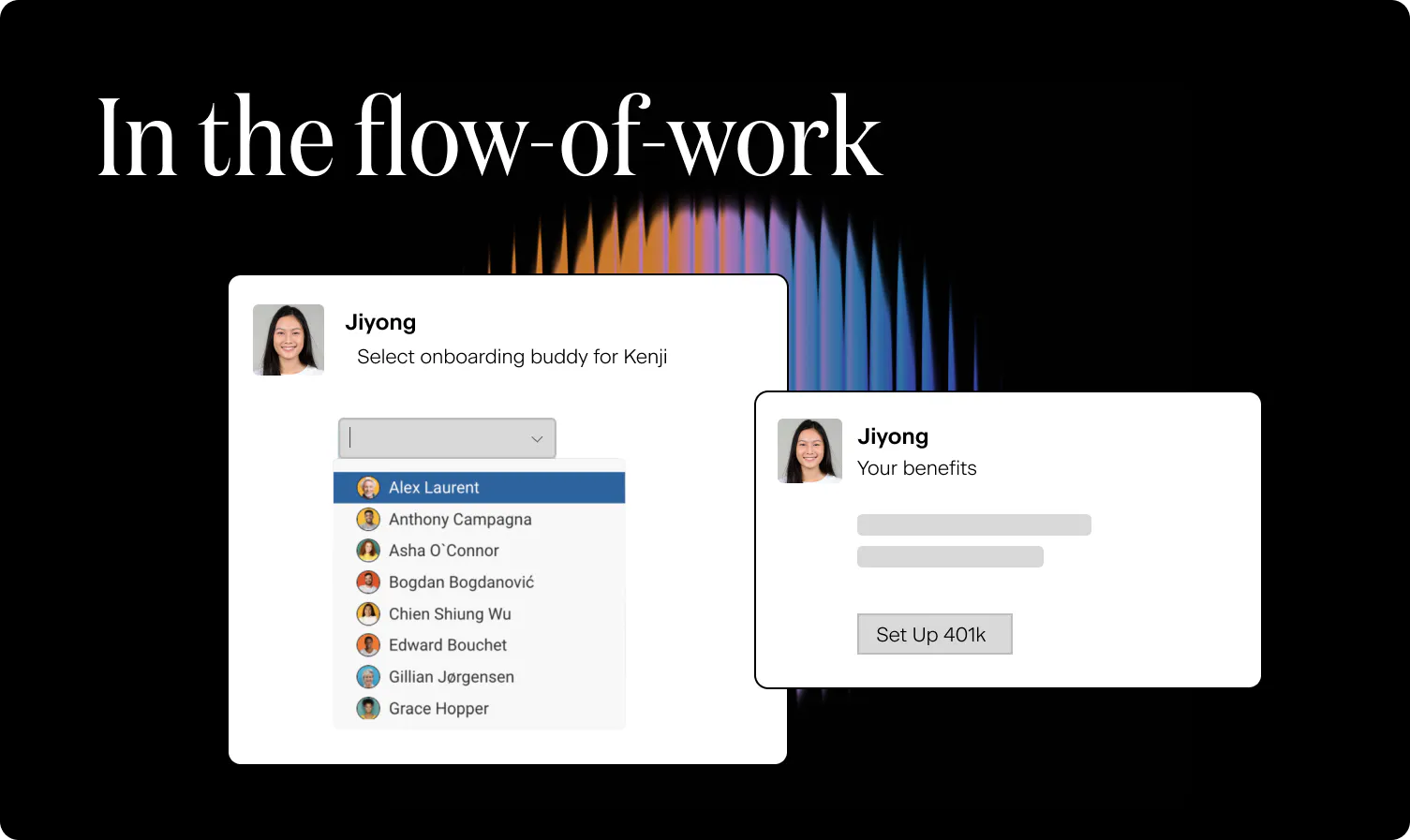
2. They keep most tasks "in the flow of work"
The best onboarding experiences meet people where they already work.
Instead of asking new hires or managers to jump between multiple systems, information and actions should appear directly in familiar tools, like Slack, Teams, or Email.
If an action must occur in another platform, include deep links right in the message (for example, a Slack notification that takes a manager directly to the HRIS task).
This reduces friction and increases completion rates.
3. They connect and trigger tasks across systems
In many organizations, one action triggers another — for example, a signed offer in Greenhouse (ATS) might create a record in Workday (HRIS).
At scale, leading companies connect many more systems to keep everything moving automatically.
If direct integrations are unavailable, tools like Pyn can connect multiple platforms in a lightweight, cost-effective way.
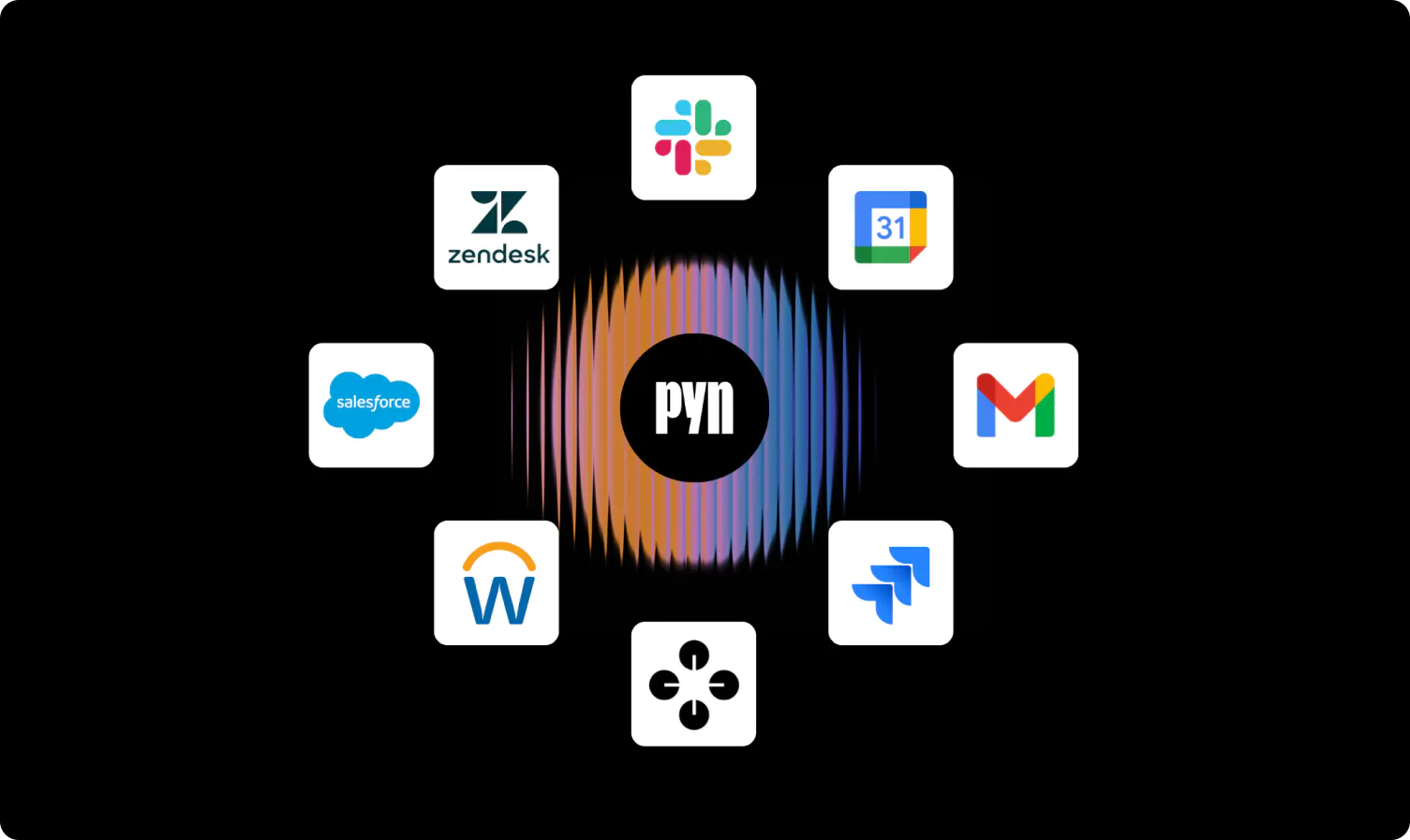
Common examples of triggered actions:
✍️ Offer Signed (ATS) → Create record (HRIS)
📧 Start Date (HRIS) → Send message to personal email (Email)
🧾 Form Entries (Email) → Update record (HRIS)
☑️ Start Date (HRIS) → Create IT ticket (Task Management like Asana, JIRA, ServiceNow)
🙌 Start Date (HRIS) → Manager selects new-hire buddy (Slack)
📅 Start Date (HRIS) → Add to onboarding class calendar (GCal)
💬 Start Date (HRIS) → Direct Message from HR coordinator to hire or manager (Slack)
👥 Demographics (HRIS) → Add to relevant Slack groups (Slack)
👩🏽🎓 Team (HRIS) → Enroll in relevant learning course (LSM)
⏱️ 30–60–90 days (HRIS) → Send polls or check-ins (Slack)
🎉 100 tickets milestone (Support Platform) → Send manager nudge (Slack)
♥️ 90 days (HRIS) → Request feedbeck/review (Glassdoor)
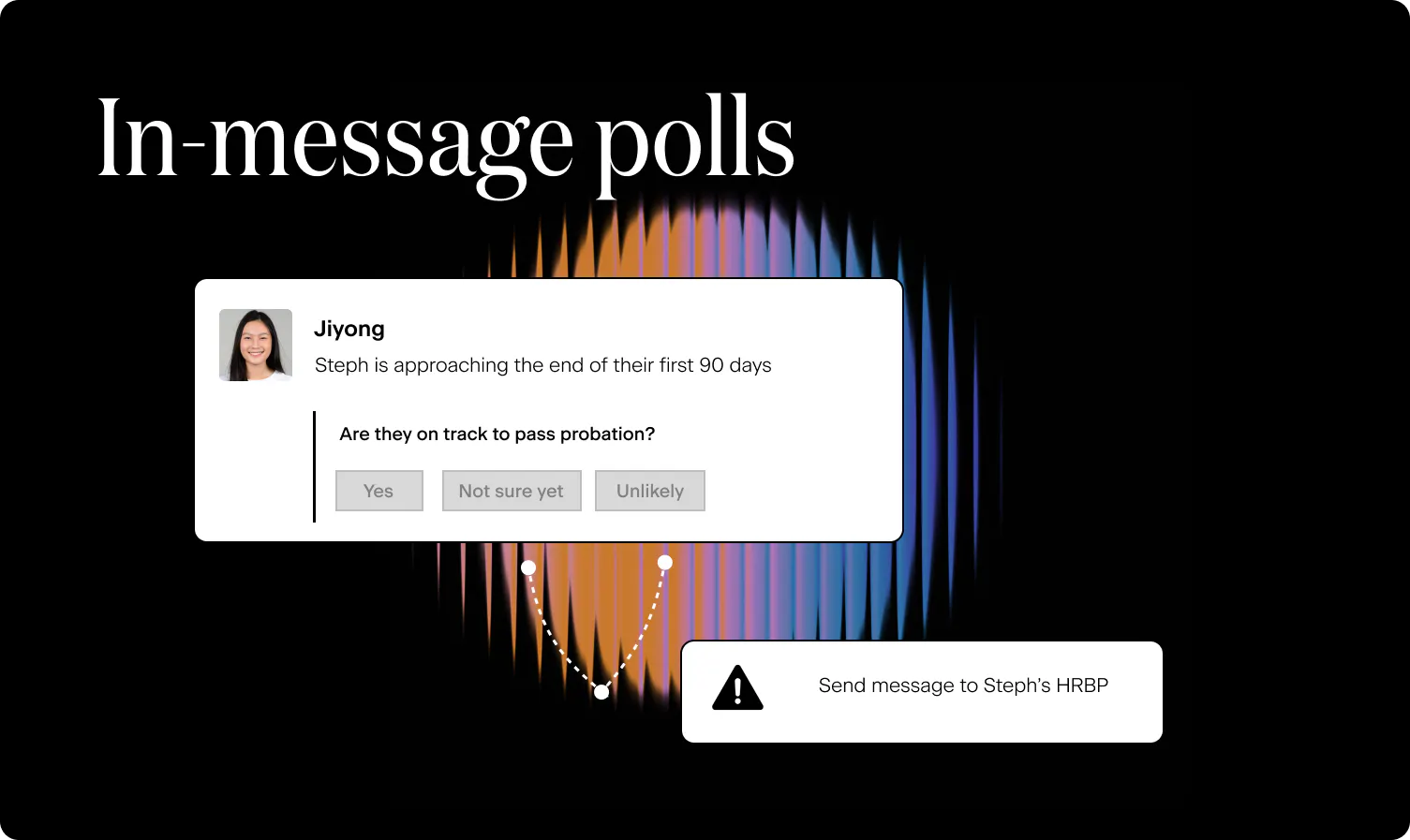
4. They use "Polls" to reduce risk and improve continuously
Quick polls are a powerful way to measure how onboarding is landing and to fix issues early.
Use short, automated check-ins with new hires, buddies, and hiring managers to understand their experience, identify friction, and validate progress.
A quick manager poll at the 30- or 60-day mark can also flag performance risks early - for example, whether a new hire is on track to pass probation.
These simple feedback loops turn onboarding from a one-time process into a continuously improving system.

Crafting the perfect onboarding message
Do you ever feel like your messages to hiring managers, new hires, or other stakeholders are going into a black hole?
Well, you’re not alone.
Crafting effective employee communications takes time, and that’s something most HR teams are short on. But when messages don’t get read or acted on, onboarding slows down, deadlines slip, and employees feel lost. Lindsey Caplan wrote about communications tips, some outlined below.
Four things we found high-performing companies do to lift readership and action rates.
1. They don’t stuff the suitcase
We often approach communication like we do packing for a trip; throwing everything in, just in case.
In onboarding, that means overloading messages with too many links, tasks, or details. While it feels thorough, it can leave new hires feeling overwhelmed and disengaged.
There’s such a thing as too much onboarding. Overloading a new hire with so much information that they’re left feeling overwhelmed and dissatisfied.
Read more in HBR 🔗
To fix this:
- They avoid long checklists. Focus on a few key tasks per message.
- They distinguish between “must do/know” and “nice to do/know.”
- When employees need to take action, they make the ask clear and upfront.
For example:
- Must do/know: Have your first 1:1 with your new direct report this week.
- Nice to do/know: Here’s how to run your first 1:1 with a new report.
Clarity reduces hesitation and boosts completion rates.
2. They are action-oriented
Great onboarding communication clear articulates what the reader should do. It’s not pushy - it’s helpful. Employees, especially new hires, want to know what’s expected of them.
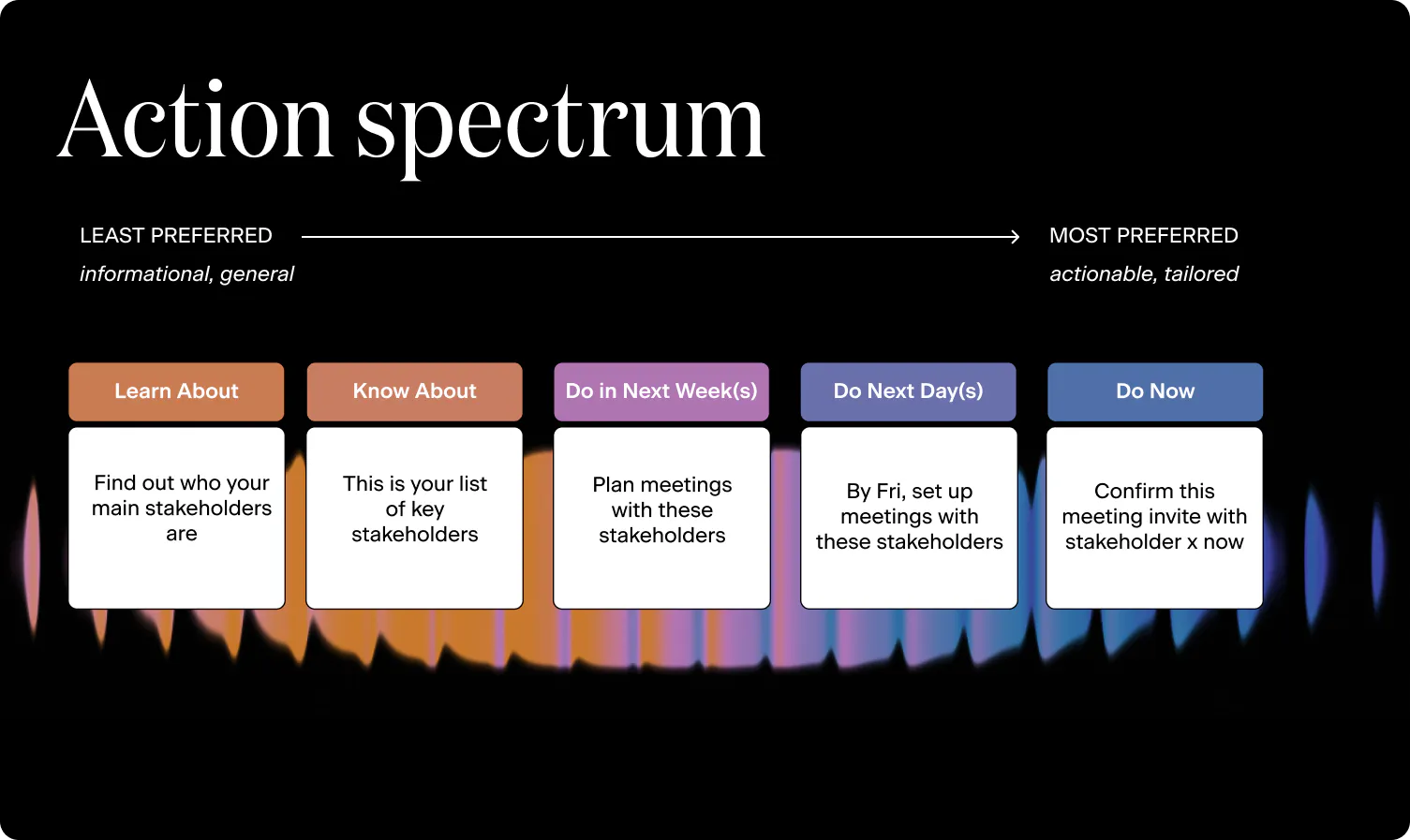
The same message can live anywhere along an Action Spectrum; from purely informational (“learn about”) to highly actionable (“do now”).
Great HR teams review their onboarding messages through this lens. Even small shifts; from “read this policy” to “acknowledge this policy by Friday”, can dramatically improve follow-through.
Use the Action Spectrum to assess how actionable your communications really are.
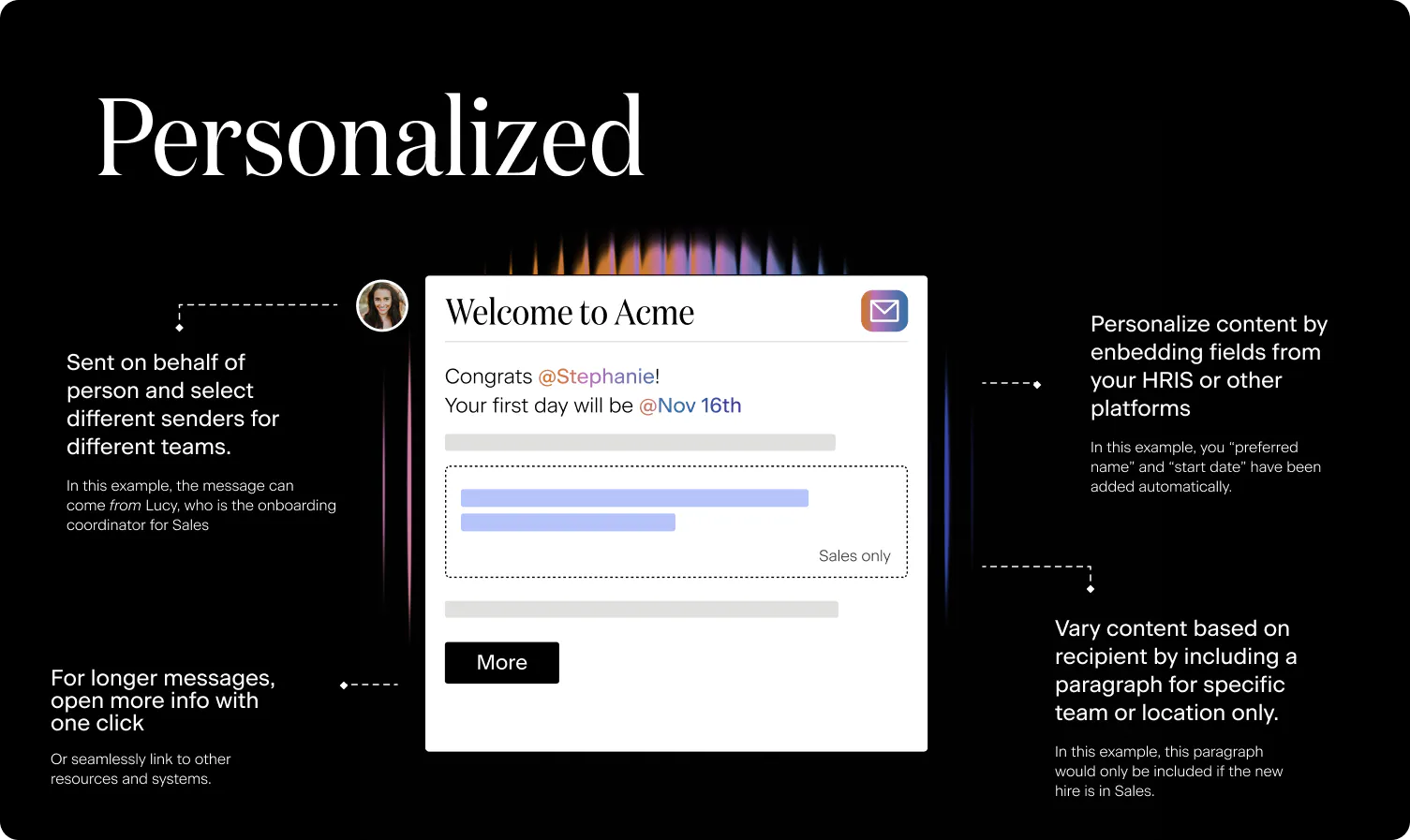
3. They personalize, even at scale
People are more likely to act when messages feel relevant and human.
Top companies move away from impersonal system notifications (like generic Workday alerts) and instead send communications that feel directly from a person, even if they’re automated.
There are three proven ways to personalize at scale:
1. Automated messages via DM or Email
Send messages on behalf of a real HR or onboarding contact. These perform far better than generic “bot” messages.
2. Conditional content
Show or hide sections of a message based on criteria like team, role, or location, so each person only sees what applies to them.
3. Embedded tokens
Pull personalized data (e.g., name, manager, start date, location) directly from your HRIS into each message.
Together, these techniques keep communication personal, relevant, and effortless to maintain.
4. They lift action rates through better visibility
When scaling onboarding, visibility drives accountability. People act faster and more consistently when expectations, priorities, and progress are visible, both for HR and for hiring managers.
For HR: Tracking Actions and Opens
Dashboards or reports help HR teams identify what’s working and where things stall.
Track:
- Open and action rates – see who’s engaging and who needs reminders.
- Individual vs. aggregate insights – spot trends by team, department, or region.
With these insights, HR can intervene early, adjust timing, and continuously improve the onboarding experience.
For Hiring Managers: My Week Ahead Digest
Managers often juggle multiple new hires at once, and it’s easy for tasks to get buried. A weekly “My Week Ahead” digest helps them stay organized by summarizing:
- All upcoming and outstanding onboarding tasks.
- Priority cues; what’s urgent or must-do first.
- Due dates and reminders in one clean summary.
By consolidating information, managers spend less time chasing details and more time supporting their new hires, ensuring everyone starts strong.

Using AI, Automation and Personalization
Modern onboarding has moved from static checklists to dynamic, data-driven experiences. As companies are exploring use-cases for AI and Automation, onboarding is rapidly changing. Four changes that we observed:
1. They seek to automate the predictable, and personalize the content.
Companies are exploring automation (RPA, integrations, workflows) to handle repetitive admin with tools like Pyn, UiPath, and Microsoft Power Automate to manage contracts, access, scheduling.
Also, rather than “everyone gets the same first-30-days programme”, new onboarding software tailors the journey based on role, previous experience, and location.
2. They let AI guide timing and relevance.
Smart systems like Pyn detect key “moments that matter” beyond the standard pre-set onboarding journey, from an engineer’s first pull request to a support rep’s 100th ticket or a missed compliance task in Workday, managers and employees can get nudged at the right time.
These triggers turn onboarding from a one-time event into a responsive, adaptive journey that evolves with real-world data.
3. They require human centered design, not bots.
Automation should amplify human connection, not replace it. The most successful onboarding programs blend data-driven personalization (role, location, experience) with genuine human moments; including manager welcomes, peer introductions, or direct Slack messages that make new hires feel seen.
4. They measure, learn and adapt.
Continuous feedback loops drive improvement. Quick polls and branching logic can surface individual needs. For example, if a new hire reports feeling disconnected, the system might prompt an extra buddy chat or team introduction.
At the process level, tracking engagement, completion, and sentiment helps teams refine timing, content, and communication style.
Platforms like Pyn make it easy to turn these insights into ongoing improvements.

Design for the outcome you seek
What do you prioritize between Compliance, Ramp speed, and Assimilation
40% of overall employee turnover occurs within the first year of employment
Work Institute’s 2025 Retention Report 🔗
There are three key parts to effective onboarding:
- Compliance: Getting people set up correctly with all the required paperwork and systems access.
- Ramp Speed: Helping new hires become productive as quickly as possible by creating clarity and early goals.
- Assimilation: Helping people feel connected to their manager, their team, and their environment and role
When designing onboarding programs, most companies focus heavily on the first two; Compliance and Ramp Speed. But the most successful organizations prioritize Assimilation, because it has the greatest long-term impact on engagement, retention, and performance.
Design for Assimilation First
If you pause and rank your priorities, the ideal order is:
1️⃣ Assimilation → 2️⃣ Ramp Speed → 3️⃣ Compliance
Design your onboarding process with Assimilation as the core outcome. Then, layer in Ramp Speed and Compliance around it.
That means starting with questions like:
- How will we help new hires build a strong relationship with their manager?
- How will they form meaningful connections with their team?
- Which stakeholders do they need to meet early?
- How can we support buddy programs or skip-level connections?
Why 90-Day Plans Matter
Many companies view 90-Day Plans as “extra work,” but they’re one of the best tools for driving both Assimilation and Ramp Speed.
A well-designed 90-Day Plan structures early conversations, clarifies expectations, and ensures new hires are connecting with the right people and priorities, setting the foundation for both productivity and belonging.
The ideal process start to finish
Without structure, new hires (and hiring managers) can feel unproductive and adrift. Below a list with all the information, tasks, and automation flows to consider including.
What mosts companies include
Upon Signing Offer
🎉 Congratulations! to celebrate the offer acceptance, express excitement, and share that HR will be in touch soon with next steps. [Hiring Manager → New Hire]
🤝 Welcome to [Company] to outline what’s next: background checks, paperwork, start date confirmation, and who to contact for questions. [HR → New Hire]
Week(s) before start
📋 Complete Your Paperwork to prompt to complete Workday (or BambooHR) tasks — contracts, tax forms, personal info. [HR → New Hire]
🗓️ Manager Prep Reminder to remind manager to prepare Day 1 plan, welcome message, and first-week goals. [HR → Manager]
💻 Tech Setup & Access Confirm shipping or setup of laptop, accounts, and credentials. [HR → New Hire]
❤️ Company Culture Preview to share short, engaging content: mission, values, how people collaborate. [HR → New Hire]
Day(s) before start
🗺️ Your First Week Plan to provide a simple schedule for the first few days, including orientation or welcome sessions. [HR → New Hire]
🧾 Manager Prep Checklist to ensure pre-start prep: workstation, introductions, first tasks, early 1:1s.💡 [HR → Manager]
📣 Manager Nudge to encourage sending a personal “we can’t wait to see you Monday!” message. [HR → Manager]
🚀 Final Countdown to confirm arrival time, what to bring (if in-person), how to log in (if remote). Reassure they’re ready to go. [HR → New Hire]
First Week
👋 Welcome (Day 1) to greet starter, walk through first-day plan, and first tasks. [Manager → New Hire]
🧭 Orientation Details to link to HR sessions, payroll setup, org chart, compliance checklist. [HR → New Hire]
📚 Tools & Resources to highlight key systems, help channels, FAQs. [IT / HR → New Hire]
✅ Manager Reminder: 1:1 Setup to prompt to schedule recurring 1:1s and 30/60/90-day check-ins. [HR → Manager]
🌟 Team Introduction / Social Moment to nudge for lunch invites, fun intro in team Slack, or quick icebreaker session. [Team → New Hire]
Milestones over first 3 Months
🪞 End of Month 1 “How’s It Going?” to reflect on first month, clarify priorities, gather feedback [Manager → New Hire].
📈 Month 1.5 “Survey / Pulse Check” to do short onboarding poll or survey or NPS. [HR → New Hire]
🎯 Start of Month 2 Growth Conversation to discuss early wins, learning areas, upcoming goals. [Manager → New Hire]
🗂️ “Probation Review Reminder” to prompt manager to schedule and prepare the probation-review meeting. Include checklist: performance summary, feedback from peers, development plan. [HR → Manager]
🧑🏽🤝🧑🏼 Month 2.5 “Stay Connected” Remind to connect employee with mentor, community, or ERG. [HR → Manager]
🥳 End of Month 3“Congratulations – You’re Officially Onboarded!” to celebrate milestone, recap achievements, explain what’s next (e.g., performance review cycle). [HR / Manager → New Hire]
What other things to consider including
👫 ERG Introductions to introduce the diferent ERGs and facilitate the sign up and welcome process [HR → New Hire]
💌 Buddy / Mentor Introduction to introduce their buddy or onboarding partner. [HR → New Hire]
🙋🏽♀️ Buddy Check-In Reminder to prompt buddy to send a short “looking forward to meeting you!” DM next week. [HR → Buddy]
💬 Buddy Check-In #1 for an informal “How’s it going so far?” DM or coffee chat invite. [Buddy → New Hire]
🏢 Welcome to the Team! “Meet your team” DM or intro post in Slack. Future [Teammates → New Hire]
🎥 CEO Welcome (video) message to welcome a new hire and provide deeper information about the company [CEO → New Hire]
🧍🏽♂️ Welcome Post Draft Reminder to announce new hire in team Slack or all-hands. [Manager → HR or Internal Channel]
? 6 months Key Questions to ask about the journey to date, if expectations are met, and any feedback they have [HR → Manager & New Hire]
💌 Welcome package or care kit (branded swag + personalised note) so the new hire feels valued immediately. [HR → New Hire]
🙌 Micro-Survey or Personal User Guide: ask the new hire what motivates them, what they’re nervous about, what they like/learn, and other personal style questions. Use that data to personalise their first month. [HR → New Hire]
🎯 First meaningful task or “mini-win” within the first week so the new hire experiences competence and momentum. [Manager → New Hire]
💔 Branching logic in the onboarding journey: e.g., if new hire scores low on “feels connected” survey → insert extra buddy session or team intro. [HR → New Hire]