
Creating

Company

Values
The ultimate guide on developing your company culture through behavior-informed values





Foreward
To control culture in complex remote teams is incredibly hard. But the techniques described in this guide make engineering culture more within our reach than ever before.
“Important about hybrid work is the intentionality and effort necessary to maintain culture. Culture has always been a challenge to strengthen and sustain, but with hybrid work models, the level of difficulty will be increased many-fold.”
— Tracy Brower. Author “Secrets to Happiness at Work”
Company values play an important role in scaling culture as they can provide behavioral guiding lights on how to deal with any situation. But having company values is not enough. There are enough companies with aspirational values but a bad culture. This guide shows you how to successfully scale your culture with behavior-informed values.

About values, culture and behaviors
What keeps your company special as you grow?
Why does your company need values? To explain, here's a story about my growing family
My partner and I just had a baby. He is very sweet, but we realize our family culture has changed completely. Where used to have a culture of sleeping in on weekends. Now we have a culture of getting out of bed at 7am - - every day! Baby = new culture.
So, how do we keep our family together? And, what keeps your company special as you grow?

The most important thing is that my partner and I hold similar values. We both like politics and social justice issues. We both need to stay creative. It is those shared values that will keep us together, even when our culture changes. And hopefully we will be able to instil some of those values on our little baby when he grows up.
This is why it is so very important to write down your company values.
What is company culture again?
Go online, and you’ll find many ‘definitions’ of company culture, like, “A set of shared values, goals, attitudes and practices that characterize an organization” or, “What happens when the boss is away.”
Regardless of definition, the common thread is that company culture reflects the behaviors of our people.
Another, more actionable and measurable way to define culture is by describing it as follows:
“If two thirds of the team are doing something two thirds of the time, consider that behaviour as part of your company culture.”
— Joris Luijke. Cofounder Pyn
So, if two thirds of your employees are having lunch together two thirds of the time - you have a culture of having lunch together.
Get more people to do something more often and you can impact culture. How to do that is explained in the second part of this guide.
Why CEOs worry about their company culture
Most CEOs and company leaders worry a lot about their company’s culture. Because these company leaders watch their culture morph over time, sometimes into something they don’t want, yet feel powerless to stop.
This anxiety is justified. There are many examples of culture failing companies. A company’s culture may be great now, but without work it won’t last.
Take companies like Lehman Brothers or Uber where culture broke down, at least temporarily.
It’s important to note that such companies often developed great company values. But communicating these values isn’t enough to stop culture from going pear shaped.
Also, very few of the people working at those companies were bad people. As a matter of fact - all those companies are filled with smart, talented people with aspirations to be great.
It just shows that depending on the good of people or company values alone won’t be sufficient. Companies have to actively guard and influence culture.
How behaviors affect culture
How do you ensure employees are less likely to behave in ways that have unintended consequences that affect culture? And on the other hand, how do you reinforce behaviors that build the company culture you want? In order to shape company culture, you need to change behaviors.
And how do you make sure you don’t do that in a ‘manipulative’ way? Nor through ‘control and command’?
Bringing your values to life (and how to keep ‘em alive)
This guide covers both familiar and new methods companies use to engineer company culture through (1) creating and (2) scaling values.

Create: Covers the less familiar topic of a framework for structuring values as well as how to workshop selecting the right values.
Scale: Covers more common HR practices to “introduce” and “reinforce” values and dive deeper in newer techniques used by people teams to “ensure people act accordingly with values especially at times it matters most.”

Part 1. Create
“You don’t set core values, you discover core values."
Management guru, Jim Collins said that “You don’t set core values, you discover core values."
In this chapter you will get some ideas on that discovery process. We will present you with a framework on how to structure a great company value - using 8 rules. And we will discuss some ways to ‘workshop the values selection process.

The 8 rules; a framework for structuring values
I've been involved in value creation several times and talked to countless HR leaders on what makes a great company value. Based on those learnings, we created a list of 8 rules to develop a framework for a great value.
Two notes before diving in:
- These rules are not binary. See it as a scale. Complying with the rule more would be better.
- You will not tick all boxes for every value you suggest.
1. Someone can reasonably disagree
Values like, “Fairness” aren’t as powerful, because they are almost impossible to disagree with because no one could possibly want an ‘unfair’ company. A company value we had at Squarespace like “Good work Takes Time” is better as it provides direction (and in this case an opposite to Facebook's "Move Fast Break Things")
Examples
- Move fast (Facebook)
- Good work Takes Time (Squarespace)
- Defend and respect the user’s voice (Twitter)
- Embrace Team over self (Southwest)
- Great just isn’t good enough (Google)
2. I’d tell a friend about it
Great values are remarkable and interesting - which helps folks remember them. One of our Atlassian values is “Don’t f%&ck the Customer”. Not everyone’s cup of tea - but people didn't find it hard to recollect them - even after many years :-)
Examples
- You can be serious without a suit (Google)
- We are on the offense – always (Nike)
- Design is not a luxury (Squarespace)
- Don’t f%&ck the Customer (Atlassian)
- Reach every person on the planet (Twitter)
- Create Fun and A Little Weirdness (Zappos)
- Warrior Spirit (Southwest Airlines)
3. It can help make a decision
If you can finish this sentence in your company, your value will be stronger: “when confronted with situation x, remember that… [enter value]”. The value speaks directly to the person to guide them on what they should do. They serve as a universal north star, aligning team members on how to address challenges or disagreements.
Values like “Continuous Learning” are harder to help you make a decision. (when you wonder what you do in situation x, remember… continuous learning). Google’s value like “Fast is better than Slow” helps people decide what path to take at work as you could imagine finishing the sentence above with that value (when you wonder what you do in situation x, remember… fast is better than slow).
This can be particularly meaningful in an all-remote setting with people across multiple timezones as the company's values will lead to less ambiguity in decision making.
Examples
- Great just isn’t good enough (Google)
- Seek diverse perspectives (Twitter)
- Frugality (Amazon)
- Debate then commit (Gusto)
- Question assumptions (Invision)
4. We can describe ways for people to act them out
An Atlassian value was “Be the Change you Seek”. This is much easier to translate into the 'behaviours' you'd like to see: asking employees, if anything frustrates them and they wonder why nothing has been done about it, to not complain, but to instigate change.
Examples
- Communicate as much as possible, because it’s the oxygen of a distributed company. (Automatic)
- Be the change you seek (Atlassian)
- Operate with transparency (Apptio)
5. Company Values are also Product Values
Great company values are often connected to a product mantra. Our Pyn company value of “radical personalization” both reflects how we care about the personal circumstances of our people and our product vision as it relates to employee communications.
By displaying similar behaviors to your product or service, your company’s competitive advantage is constantly reinforced both internally by your people and in your go-to-market strategy.
Examples
- Open company, no bullshit (Atlassian)
- Radically personalize (Pyn)
- Learning faster through feedback (Culture Amp)
- You don’t need to be at your desk to need an answer (Google)
- Be a host (Airbnb)
6. Company values have mutuality
Great values can often be described in terms of what they mean from an employee’s perspective as well as from a company’s perspective. There is nothing more powerful than something that is reinforced from multiple angles as it strengthens the message even more. For example, employees at Culture Amp are expected to be open to feedback to continuously learn and grow, But so is the company who frequently surveys employees to get feedback so they can be better.
Examples
- Learning faster through feedback (Culture Amp)
- Open company, no bullshit (Atlassian)
- Creating a culture of warmth and belonging (Starbucks)
7. Values should already be lived
Values should be part of the existing company DNA to a large extent. If you make up values you currently don't live, they are probably not the right ones. For example, an Atlassian value like "Open Company, No Bullshit" were words picked from conversations folks had already been using - and had been a company philosophy for some time even though it hadn't been articulated. Sure, you may want to be a bit 'aspirational', but within reason.
How do you know?
- Words you see / hear
- Stories people tell each other
- Behaviors you already observe
8. Less is more
4 values is better than 8. Every additional value after 5 will, to some extent, dilute the importance of the first 5. This is backed by research from Bick and Rabinovich who found, in their study on the storage capacity in our brains, that it is about thirty times easier to remember 4 items from a list compared to remembering 10.
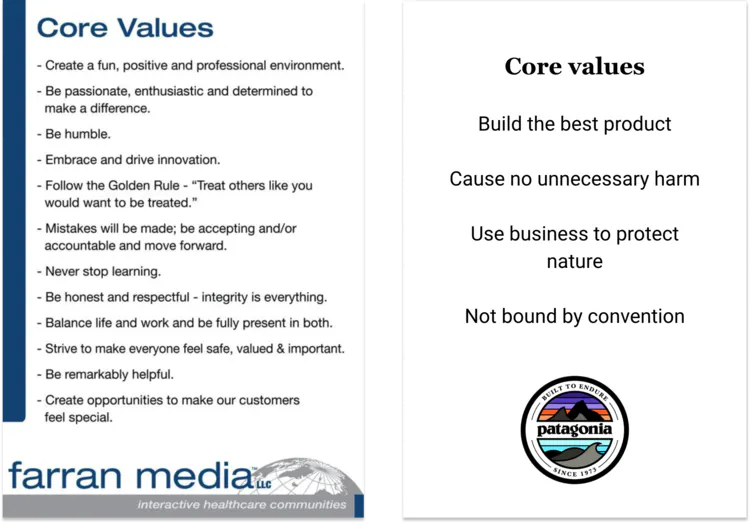
Which one would you remember?
Test yourself with these two examples. Which one would you remember better?
Do your own values assessment.
Do you want to check if your company values are well structured? Do this quick values assessment to evaluate their strength. Evaluate your values now!
Workshop to select the right values
There are several ways to “workshop” the values creation process. One exercise that stuck with me was the process at Atlassian.
Early on, the company did their version of Jim Collins’ “The Mars Group” exercise, which asks companies to “Imagine you’ve been asked to recreate the very best attributes of your organization on another planet.”

Start the process with the founders, CEOs and perhaps one or two trusted leaders. Ask this group: If we were to recreate our company on another planet, but could only bring 12 people, who would you bring? It’s very likely that the chosen people are strong performers and strong cultural advocates.
Keep in mind, the people you pick should be:
- From across different teams (how would you run your business otherwise?)
- From different levels (you wouldn’t want to bring only people managers but a nice mix of individual contributors and managers)
- Diverse and represents different demographics and backgrounds.
Get these people to define the values based on the framework (and the 8 rules) presented above. In addition to this group of 12, you could ask the executive team to define the company values separately, and integrate the two lists later.
In the earlier days of Atlassian, the management team and selected Atlassian employees each came up with a list of values. I remember my old boss (Atlassian’s co-founder Mike Cannon-Brookes) saying how fascinating and gratifying it was to find a huge overlap between the two lists. After some discussion, a merged version became the core values.

Part 2. Scale
“Ensure people act accordingly with values especially at times it matters most.”
It’s one thing to create values. It’s another to have every employee living by those values.
In Scale, we will first cover more common HR practices to “introduce” and “reinforce” values and dive deeper in newer techniques used by people teams to “ensure people act accordingly with values especially at times it matters most”

Introduce company values
Scaling company values, starts with introducing them to new people who join your organization. Every hire, regardless of position or location, should learn and understand the company values.
New hires are generally very open to new information in those very early days (before their calendars are being filled with meetings and projects). So, they’ll be more likely to read that story of an employee living the values (storytelling works great!) or watch a video explaining how the values relate to the day to day job.
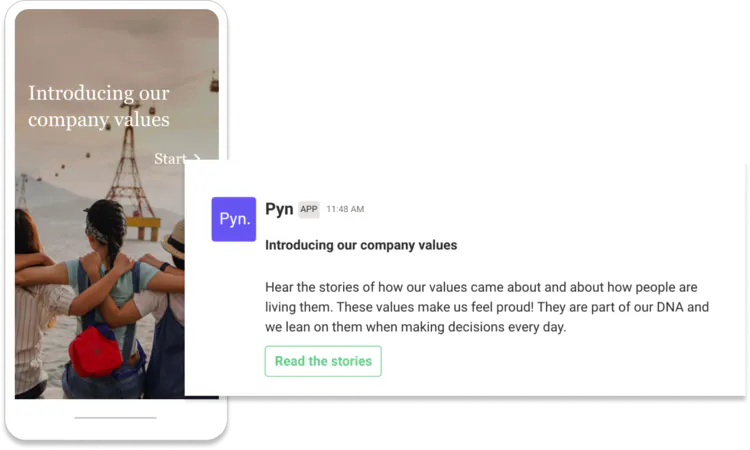
It can be very effective (and fun) to send stories and explanations about the company values in the pre-boarding phase, before the person’s first day.
Reinforce company values
There are plenty of opportunities to remind people of the company values.
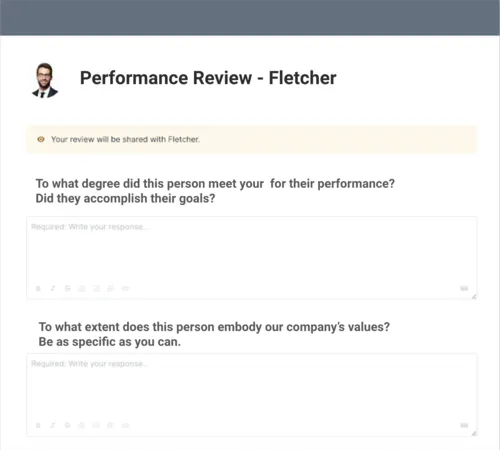
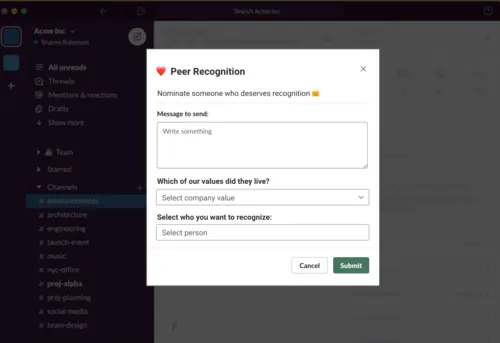
Many modern People Teams ensure that values feature in common people practices where people’s behaviors are under the spotlight, including for example during recurring performance reviews and as part of high volume practices like peer-to-peer recognition.
Ensure people act accordingly when it matters most
Throughout the employee journey, there are certain moments where behaviors can have an outsized impact on the culture you want to create or reinforce. Guiding behaviors during those moments is crucial if you want to scale culture. Some of those moments include:
- Life moments: birth of child or a return from long term illness
- Transition moments: moving teams or promotions
- Crisis moments: layoffs or a security break
- Cyclical moments: rituals around salary reviews or goal setting
- Organizational moments: moving to remote or a reorg
Forward thinking People Teams are mapping these moments out as part of the Employee Journey - a visual representation of an employee's experiences in your company across all important moments.
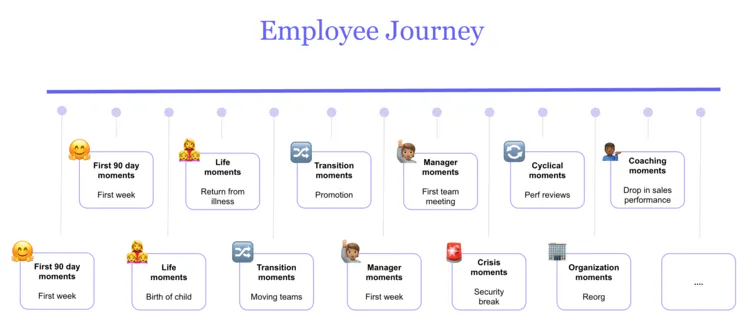
Check out Pyn’s Employee Journey Map to identify important employee moments
There are new ways to guide employees through those moments allowing companies to instill behaviors in employees and managers that are in line with the culture the company aspires to build or maintain.
Technology has made major advancements in recent years. Before, People Teams would have to identify when a particular event took place for one of the many employees in their company and then manually send helpful information to employees at those moments. Now, software like Pyn allows companies to automatically send employees highly personalized guidance at moments that matter most.
This modern approach uses similar processes to successful marketing software like HubSpot. For many years, marketing tools like HubSpot have allowed marketing teams to communicate to leads across the customer journey.
Now, similar tooling is available to HR. These tools apply such techniques in an organizational setting. These new tools help companies automatically send contextual information and target employees when they experience important moments throughout their employee journey.
How modern tools can reinforce employee behavior:
1. Timely
Putting a message in the person’s own contextual setting will make them more likely to act.
We send our people generic templates all the time.
2. Ease
By making it super easy to do something or act a certain way. Easier to do it than not to.
Of course you can educate your employees the importance of recycling, but putting a large paper bin next to a copy machine works better in changing behaviors. Cause it’s easy!
We put a lot of focus on explaining why we want people to do something that we forget about making really easy.
Remove any friction and make it easier to do something right then to do it any other way
3. Personalized
Putting a message in the person’s own contextual setting will make them more likely to act.
We send our people generic templates all the time.

For the first time, technology makes it possible to shape culture by shaping behavior.
We would love to demo Pyn and show you have you can scale your company culture!